When Māori health advocate Sir Mason Durie created Te Whare Tapa Whā as a way of describing Māori health and wellbeing in 1984, he never imagined it would end up inspiring people working across a range of different industries including infrastructure, planning and climate adaptation.
When asked about the model’s impact, Sir Mason said it came about because he felt that clinical approaches by themselves were insufficient to promote wellness, particularly for Māori patients. The model asks clinicians to consider spiritual and wellbeing aspects as well as physical health.“I was quite surprised that it was picked up by a lot of groups, a lot of professional people... it wasn’t just to cure a sickness, but to help people be well in every sense of the word.”
- Sir Mason Durie, interview with Te Karere, January 2021
Forty years after he created it, his model is still being used not just in the health sector but by all sorts of organisations across Aotearoa, as a way of incorporating a Māori world view into their thinking and strategy.
Principal Kaiwhakatere (Project Navigator) John Blyth and Business Director – Climate Resilience Cushla Loomb of Beca have found the model to be a useful way of encouraging organisations to take a holistic view – particularly when thinking about climate adaptation and resilience.
“It’s so solid in its underlying premise, and so relevant to Māoridom. You mention it to anyone who works in a Māori space and they know it, and then it’s easy to translate its outcome and goals,” John says.
“I’ve personally leaned into the model for a long time at Beca, but not been overt about it in the past, but I think now, the time is right. People are now looking for a different way - acknowledging that meeting the challenges of climate change from a ‘Ngāti Western’ perspective hasn’t exactly worked. So it has opened the door to looking at things in a more holistic way,” John says.
“Ancestral intelligence is relevant here. If humans weren’t geographically located in a problem area, there would be no problem. Climate adaptation isn’t about infrastructure, it’s about people. You can’t ignore that aspect of climate adaptation – it’s about moving people’s lives, and that always tops infastructure in my view. Te Whare Tapa Whā is all about people, so it’s an easy conversation, because it puts people first,” John says.
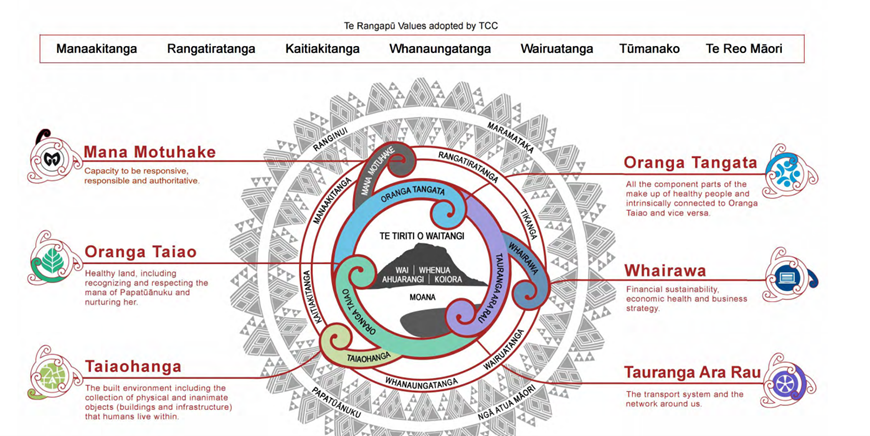
Business Director – Climate Resilience Cushla Loomb says Te Whare Tapa Whā principles helped inspire Tauranga City Council’s Climate Action & Investment Plan approach.
“There were several ideas based on different pūrākau (legends) being proposed by Tauranga City Council’s iwi liaison group, Te Rangapū. In the end, we worked together to bring all of those ideas into a model that is based in Te Whare Tapa Whā – it was a conversational conduit to the outcome and framework that was used, and it proved to be something everyone could get behind.”
Te Whare Tapa Whā also enriched conversations with Auckland Council, when they were working on their Adaptation Targets Framework.
“Auckland Council were seeking a way to tie their actions in their Climate Action Plan back to specific risks and desired outcomes to assist with ongoing monitoring and evaluation. The Beca team worked with cultural advisors from Auckland Council to develop a framing for objectives based on Te Whare Tapa Whā that allows connections between the problems/risks. This was a project where we took the climate action plan for the Auckland region and helped the team link risks with actions and key objectives, particularly cultural objectives,” Cushla says.
Does this represent a trend across Aoteaoroa New Zealand? Do organisations see the value in indigenous knowledge?
“Optimistically I’d like to say yes, there’s a real drive towards more indigenous thinking in our industry, but there’s also a very ingrained view of the world, in our sector, that it’s about infrastructure first. It very much depends on the leaders in an organisation,” John says. “Some, like Auckland Council, are all in, and others are not so sure.”
“We’ve certainly seen a real push in the Pacific for a long time, where leaders are putting nature in the middle of the options. We’re definitely seeing more nature-based solutions being proposed,” Cushla says.
Using models based on Te Whare Tapa Whā helps organisations take a multi-dimensional view of the enviroment.
“Rather than being confined to a one dimensional or single plane framework, using Te Whare Tapa Whā is a smart way to go about things as it also grounds thinking in spatial reference,” Kaiwhakatere Jason Tate says. “It’s a real collaborative approach by drawing on the wisdom of past, present and future. Everyone contributes to the final solution. The four cornerstones, taha tinana, taha wairua, taha whānau and taha hinengaro have long existed within te ao Māori. What Sir Mason Durie did was elegantly synthesise them into a framework specifically for mental health and wellbeing practice. We’re now adapting that same framework to a knowledge management system aligned to a specific target group enabling them to make well informed decisions, which align with the outcomes we’re aiming for.”
Authors