
Long-term plans (LTPs) are one of the most important tools councils use to shape the future of local communities. They outline how services will be delivered, how infrastructure will be maintained and renewed, and how investment will be prioritised over the long term.
The purpose of long-term planning is to agree a prioritised list of investment activities within a limited funding envelope. Through this process councils must balance short-term needs with longer term community outcomes, while still maintaining affordability, transparency, and alignment with strategic priorities.
Today councils are bringing together more information than ever before to support their decision making, from asset data and financial forecasts to strategic outcomes and investment programmes . The combination of higher compliance costs, interest and inflation (driving rate rises) and broader cost-of-living pressures is intensifying community focus, necessitating transparent investment decisions. Looking ahead, demand for investment will keep rising while funding remains constrained.
Beca’s LTP Builder has been designed to provide a robust and transparent approach to long-term planning by providing a clear line of sight from strategy to spend, enabling integrated, evidence-based decisions and maximum value within a tight funding envelope. It brings the right information together at the right time to enable faster comparison of scenarios and more efficient decision-making.
There are challenges ahead in the upcoming 2027 – 37 long-term planning cycle, which Beca’s LTP Builder can help councils overcome through streamlined decision making and financially sustainable delivery – without compromising service outcomes.
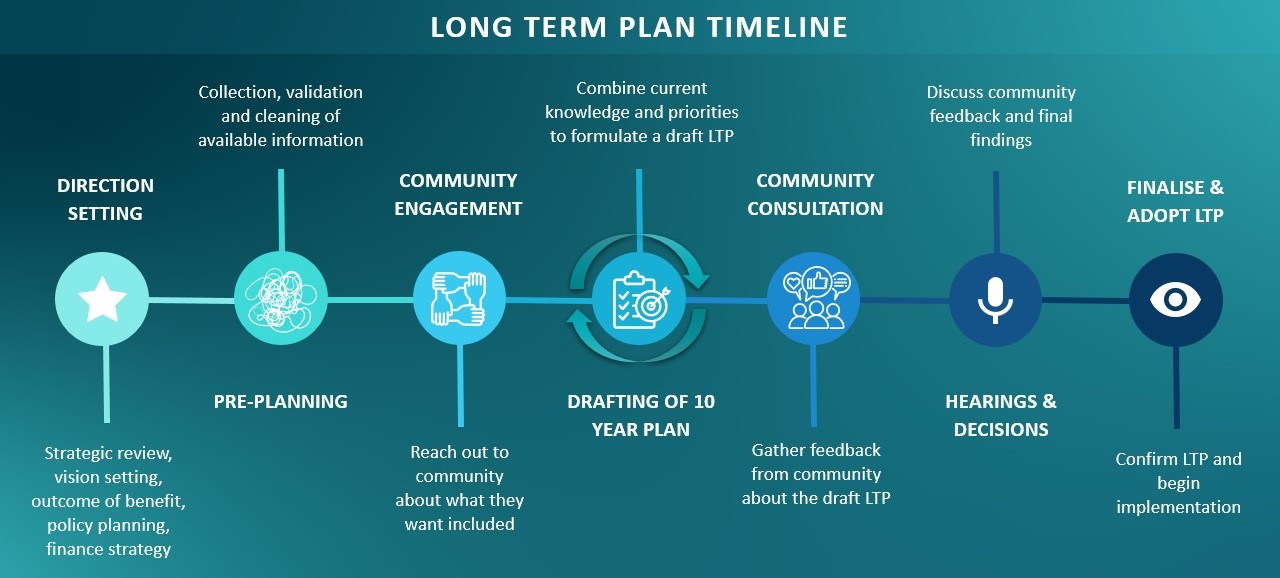
Typical long-term planning cycle
Local Water Done Well reform
During the 2024 – 34 LTP planning cycle, councils faced significant uncertainty about the future provision, ownership and management of water services. Despite this, the Deputy Auditor-General’s audit concluded that most councils met their legislative obligations and timeframes . The direction of water services under Local Water Done Well (LWDW) is becoming clearer and brings a new set of challenges in the 2027 – 37 long-term planning cycle.
A consequence of the LWDW reform is the need for two rounds of investment planning: the standard LTP process (without water assets), combined with a second LTP round based on an approved Water Service Delivery Plan (WSDP). This presents a unique set of challenges, with councils effectively needing to do twice the work in the same timeframe, with the same number of resources.
We designed the LTP Builder to support councils through the complexity of long-term planning – not by replacing expertise – but by making it quicker and easier to bring the right information together at the right time. It helps connect planning, financial, and investment data in one place, allowing clearer exploration of options and faster comparison of scenarios. This saves time through reduced preparation time and more efficient workshops, clearer communication of trade-offs, and the ability to respond to change together with elected member and community feedback without losing strategic alignment across the plan.
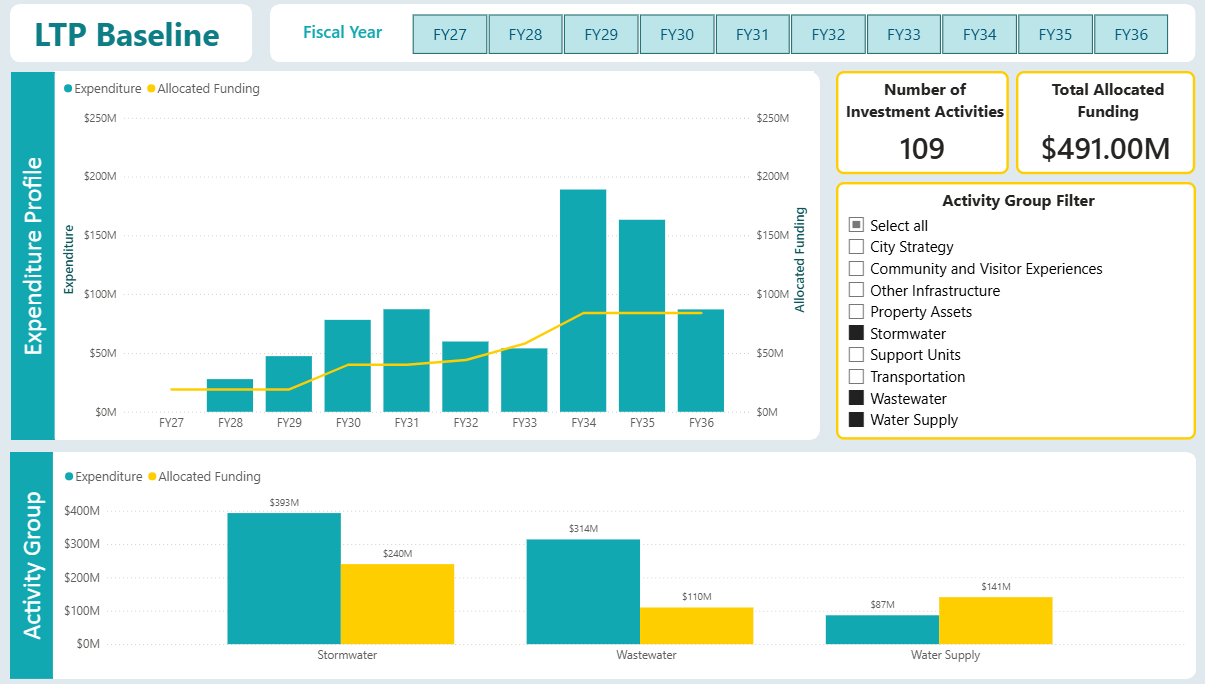
LTP Builder water activity funding breakdown
Inefficient approaches to investment planning
Understanding the impact of trade-offs is critical, yet traditional spreadsheet-driven approaches make scenario modelling slow and inconvenient. The LTP Builder provides real-time scenario modelling so that decision-makers can efficiently compare different scenarios, quickly understand the impact of their decisions and respond to community feedback without LTP project managers needing to update cumbersome spreadsheets and re-write option reports.
“By connecting data, assumptions, and investment decisions, the LTP Builder’s interactive dashboards present information in a way that is accessible for decision-makers and provides visibility of trade-offs as they are being considered.”
- Tom Garrett, Principal – Programme Advisory at Beca
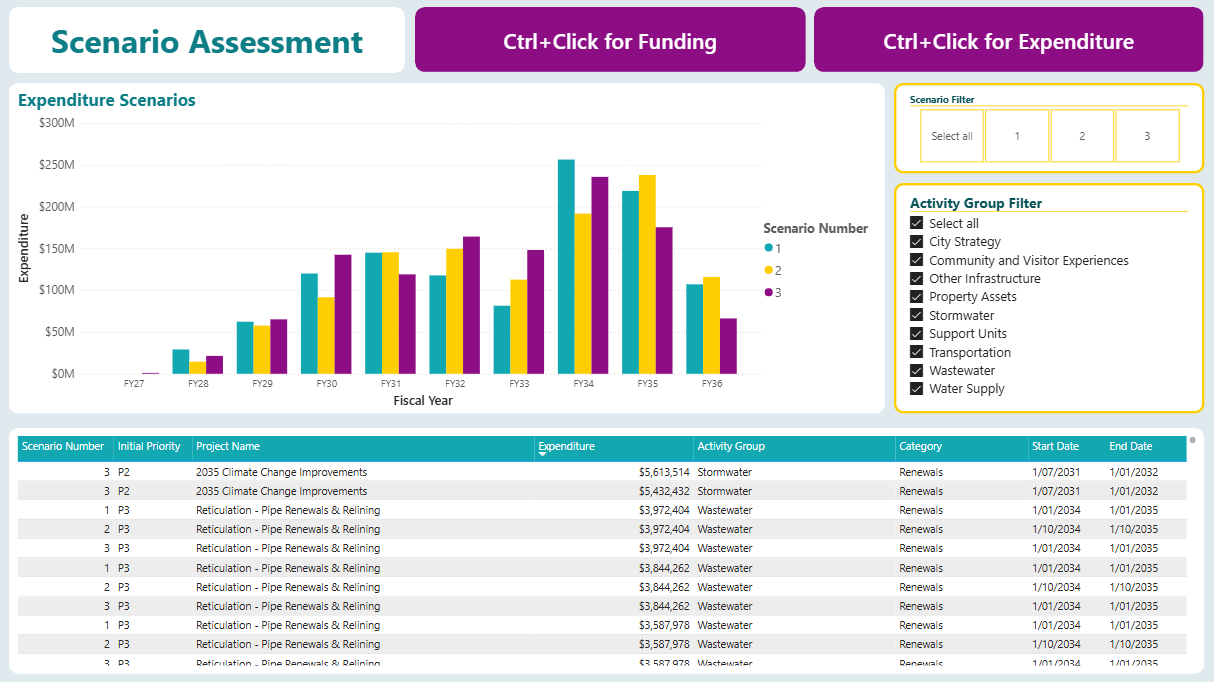
LTP Builder scenario comparison
“The Power BI interface was enormously beneficial during the consultation stage and the raw data table was invaluable when it came to making adjustments and for assessing various elements of the programme.”
Paul Tyler, General Manager Capital Programme – Regional Facilities Auckland
Accountability and transparency
The 2027 – 37 long-term planning cycle is emerging within a context of intense financial pressure (including potential rate caps), major structural reforms (including Resource Management Act reform) and high demand for infrastructure, necessitating a ‘back to basics’ approach to council services. It is clear expectations have changed. Increased regulation and sharpened community expectations are driving the need for robust and affordable LTPs.
The LTP Builder provides a clear line of sight from strategy to spend, enabling integrated, evidence-based decisions and maximum value within tight funding envelopes.
“Balancing political aspirations with strategic priorities is a common challenge many clients face. The LTP Builder applies a robust prioritisation framework to score proposed investments by alignment to strategic outcomes and funding drivers. Interactive dashboards let decision makers tune weightings to reflect priorities and feedback, revealing the optimal portfolio.”
- Tracy Plane – Manager of Strategic Advisory at Beca
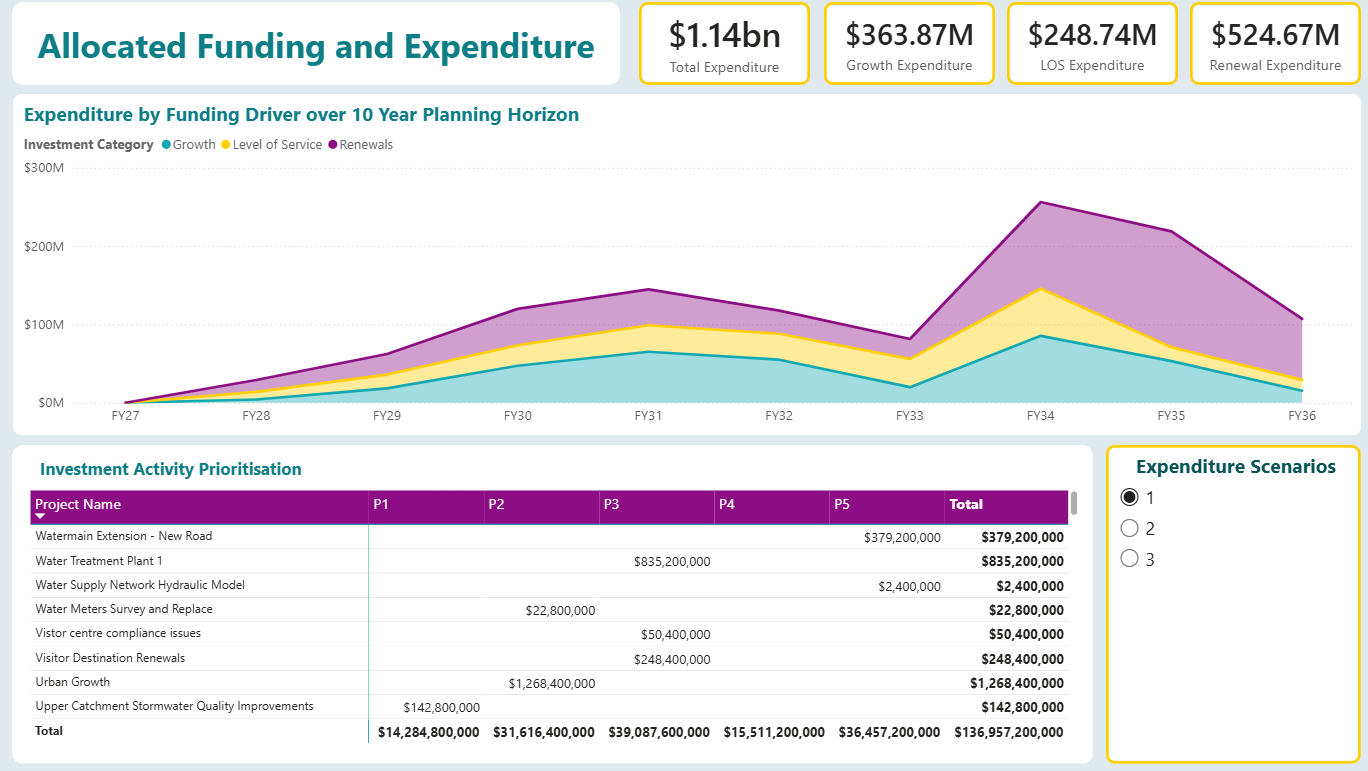
LTP Builder expenditure by funding driver
Delivery roadmapping
The LTP Builder helps councils translate a prioritised list of investment activities into a deliverable programme of works. Interactive dashboards present the LTP as a simple Gantt chart with each proposed investment activity shown as a single bar, so decision-makers can quickly and efficiently determine the optimal delivery sequence around known constraints such as asset criticality, engineering logic and legislative compliance dates. This provides a foundation for more detailed planning once the LTP is formally adopted.
Navigating uncertainty
In a world of rapid change and uncertainty, councils must remain agile while maintaining ratepayer confidence in investment decisions. The LTP Builder allows councils to efficiently re-prioritise and update their LTPs as circumstances change (for example, because of disaster recovery or regulatory reform). The LTP Builder supports continuity and transparency by establishing a baseline that can be built on over time, reducing rework and strengthening consistency across planning cycles.
As a valuable additional tool, Beca’s Climate Impact Lens provides a simplified approach to project-level review of potential climate risks and climate mitigation to enable further prioritisation of projects to take forward into LTPs.
Performance benchmarking
As part of the broad programme of local government reforms, the Department of Internal Affairs (DIA) is increasing its role in monitoring and publishing annual reports on key financial and delivery outcomes, increasing the scrutiny on council performance. The LTP Builder supports councils to meet this requirement via a reporting module that allows progress and benefits to be tracked and reported against the adopted long-term plan.
Simplifying long-term planning
In an increasingly complex long-term planning environment, Beca’s LTP Builder is designed to help councils overcome these challenges – not by replacing expertise – but by streamlining the process and enabling efficient and transparent decision-making.
If these challenges resonate with you and you’d like to learn more about the LTP Builder, Climate Impact Lens, or how we can support you and your council through the upcoming LTP planning cycle, please get in touch.