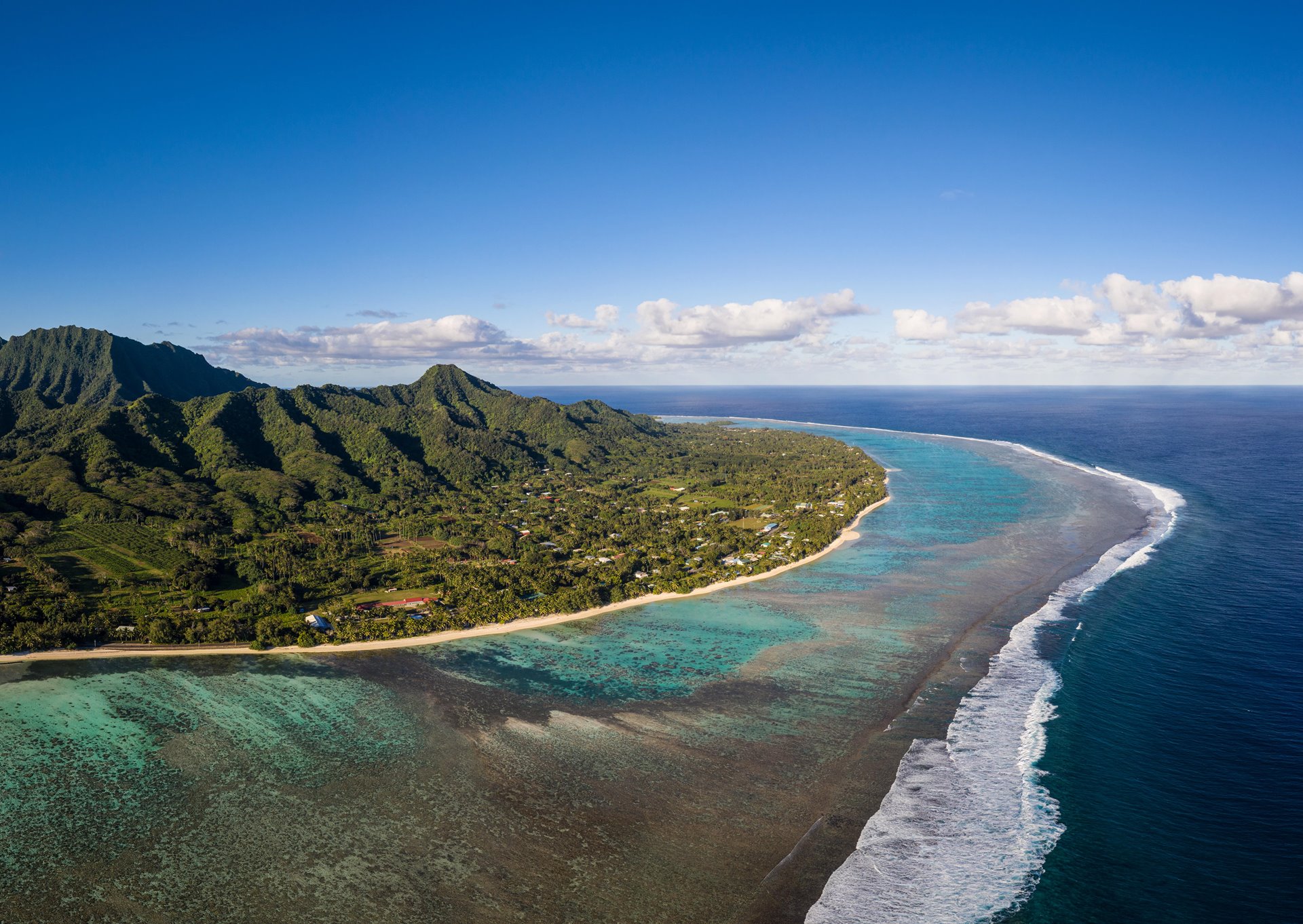
In the heart of the Pacific, the Cook Islands are on the frontline of climate change. Working with government and local subconsultants, Beca is undertaking Vulnerability & Adaptation Assessments for 15 Islands to inform enhanced resilience pathways.
An existential challenge: A nation on the frontline of climate change
For the Cook Islands, like many of its regional neighbours, rising sea levels, extreme weather events and resource scarcity aren’t just a frightening forecast, they are daily realities that locals are all too familiar with.When ferry services are cut off by storms, families in outer islands (Pa Enua) can go days without access to medical care - heightening risks for elderly residents or those with disabilities. When coral reefs decline, livelihoods are impacted along with them. Despite these challenges, the Cook Island communities remain resilient through their strong social cohesion, their various adaptation measures that combine tradition with technology, and their profound care for future generations.
However, the extent of the vulnerability of these island communities to climate change impacts is largely undocumented. That’s why the Cook Islands Government engaged Beca in 2023 to deliver a nationwide programme of Vulnerability and Adaptation (V&A) Assessments across all 15 islands of the archipelago – 12 inhabited and three uninhabited.
V&A Assessments: A pathway to greater climate resilience
The purpose of these V&A Assessments is to provide a comprehensive baseline understanding of each island’s level of exposure and sensitivity to climate change, and the adaptive capacity that exists at a community level. Information was collected using a multi-sector approach based on extensive community engagement.A key outcome desired by the Climate Change Cook Islands office is that assessments are able to be repeated over time as a way of assessing how vulnerability may change as a result of adaptation measures implemented. To address this requirement, the Beca team developed innovative ‘vulnerability indices’ to enable a comprehensive and consistent rating of vulnerability. The indices will enable future on-island users to repeat the assessments in a consistent way, whilst providing good learning and development in the assessment of vulnerability to climate change.
Beca’s scope of services included:
- Developing a standardised methodology: Creating a standardised V&A methodology and assessment templates to promote consistency and replicability in future assessments.
- Conducting V&A Assessments: Assessing the climate change vulnerabilities of each island, based on extensive engagement with stakeholders and a participatory approach with Cook Islands communities. Factors considered in the assessment for each island included demographics, water security, food security, infrastructure, health, education and economic livelihood. The team applied a lens over all assessments of gender and disability as well as cultural significance. This enabled vulnerabilities to be specifically identified for areas of greater sensitivity to climate impacts.
- Atoll Impact Analysis (AIA): The team performed a detailed analysis of specific impacts of climate change on atoll islands in the Cook Islands, which are particularly vulnerable due to their low-lying nature and limited freshwater resources.
- Evaluating adaptation barriers and pathways: Specific barriers to adaptation were identified and measures suggested that would be effective given those barriers. This included locally implemented adaptation measures through to measures that require national level support, resourcing and funding. To inform investment, adaptation pathways were tailored to the aspects contributing most to liveability on the islands (namely critical infrastructure, water and food security and land).
- Training and capacity building: A key component of the work is to empower local staff. The Beca team provided training on the V&A processes to build local capacity within the Climate Change Cook Islands (CCCI) office, and on each of the 12 inhabited islands.
Our approach: Harnessing local expertise
All too often adaptation projects are designed from afar, with ready-made “solutions” delivered “to” Pacific communities rather than “with” them. That approach misses what truly matters: the lived expertise of those on the frontlines. We chose a different path.Our approach to delivering this important project, alongside the Ministry of Finance and Economic Management (MFEM) and CCCI, was grounded in a strong foundation of cultural respect and community empowerment.
Whilst Beca has strong engineering and consulting experience across the region, we don’t have all the answers. But by asking the right questions and harnessing the local expertise of Cook Islanders – the people with daily lived experience of these climate change impacts, we were confident of uncovering valuable insights that can shape a pathway towards greater climate resilience.
We achieved this by teaming up with local consultant Teariki Rongo, and climate and coastal consultant Dr Mike Allis (who was residing in Rarotonga), and by working alongside local facilitators to create a repeatable, nationally consistent methodology that reflects each island’s unique context.
Through inclusive engagement we helped make sure the full diversity of local voices was heard, especially women, people with disabilities, and other vulnerable groups. Our community engagement activities included:
- Focus groups: Featuring women, youth, people with disabilities, growers and fishers.
- Semi-structured interviews: Held with local leaders, health professionals, educators and business owners.
- Public consultation sessions: These were hosted across all 12 inhabited islands.
- Storytelling, mapping & brainstorming workshops: These were tailored to each island’s unique context.
- Informal chats and facilitator-led exercises: These captured lived experiences and local knowledge.
The project also embedded Gender Equality, Disability and Social Inclusion (GEDSI) principles throughout, meaning:
- Vulnerable groups were prioritised in engagement design.
- Community carers and support networks were recognised as key resilience factors.
- Traditional knowledge and cultural practices were actively incorporated into adaptation planning.
Important lessons for decision makers on similar projects include:
- Listen before acting: The most effective interventions start by asking communities what they need and empowering them to deliver it themselves. This includes a special focus on what makes a community naturally resilient and nurturing that.
- Invest in building long-term capacity: not just infrastructure.
- Recognise that resilience takes many forms: Recognise that true resilience is measured not just in dollars saved or buildings protected, but in whether future generations can thrive on their own land.
Impact: Making everyday better for Cook Islanders
The Cook Islands now have a comprehensive baseline of vulnerability across all islands. This understanding will support future funding and financing proposals and enables them to target investment where it is most needed. Suggested adaptation planning pathways over the short, medium and long term based on key concerns identified by the community and what will work practically on the ground to address key areas of vulnerability, will help to guide investments over time. Most concerns relate to essential components that will allow the community to continue to live on their island as long as possible – with pathways focusing on water security, critical infrastructure and the availability of land as core requirements.The result is a robust, evidence-based framework that can be embedded in national policy. It enables Cook Islands authorities to monitor climate impacts, prioritise adaptation investments, and secure future funding. More importantly, it gives communities the tools and agency to make everyday better by shaping their own climate-resilient futures for the place they proudly call home.
Chloe Collins, Senior Business Development Advisor and Cushla Loomb, Business Director - Climate Resilience share more insights about this project here. You can learn more about Beca’s broader Pacific Development capabilities here.
15
Islands assessed
18
Month engagement
3,000+
Individual community inputs
Our Team Says
“We didn’t just assess vulnerability—we built local capability to lead future assessments”.
Cushla Loomb
Business Director – Climate Risk & Adaptation
Our Client Says
“I will be instructing all future consultation to be carried out this way as everyone participates”.
Elder
Manahiki Atoll, Cook Islands
What We've Done
Our People