
If you’re working to help communities build resilience to the changing climate, it’s now possible to bring a legion of multi-source data together to help you map out impact scenarios, potential counter measures, and the effect on your communities – all behind a simple-seeming screen. Digital innovation is giving planners and decision makers the ability to explore different options based on a vast array of data inputs that combine people, place and climate; helping to ensure today’s solutions can have continued positive impact in tomorrow’s world. Digital tools are also offering us a way to visualise and communicate complex technical information in a way that communities and other asset owners can understand so that informed long-term decisions can be made.
Longsight planning through digital twins
An increasingly popular tool for adaptation planning and investment decision making is the digital twin, a type of platform that runs virtual representations of real-world data, mirroring their physical counterparts in appearance and behaviour. Digital twins can serve as powerful decision-making tools, providing a unified view of data and systems that can run scenarios by quickly mapping different inputs for a myriad of outcomes.
Key features of digital twins include:
-
Unified Data Dashboard: A shared, comprehensive view of situational data, facilitating seamless data flow and integration across various decision-making processes.
-
Smart Models: Connected visualisations that diagnose, predict, and prescribe future actions, offering a holistic understanding of decision impacts.
-
IT and OT Connectivity: Integration of information technology (IT) and operational technology (OT) systems, bringing rich asset data to the forefront and enabling user-specific insights.
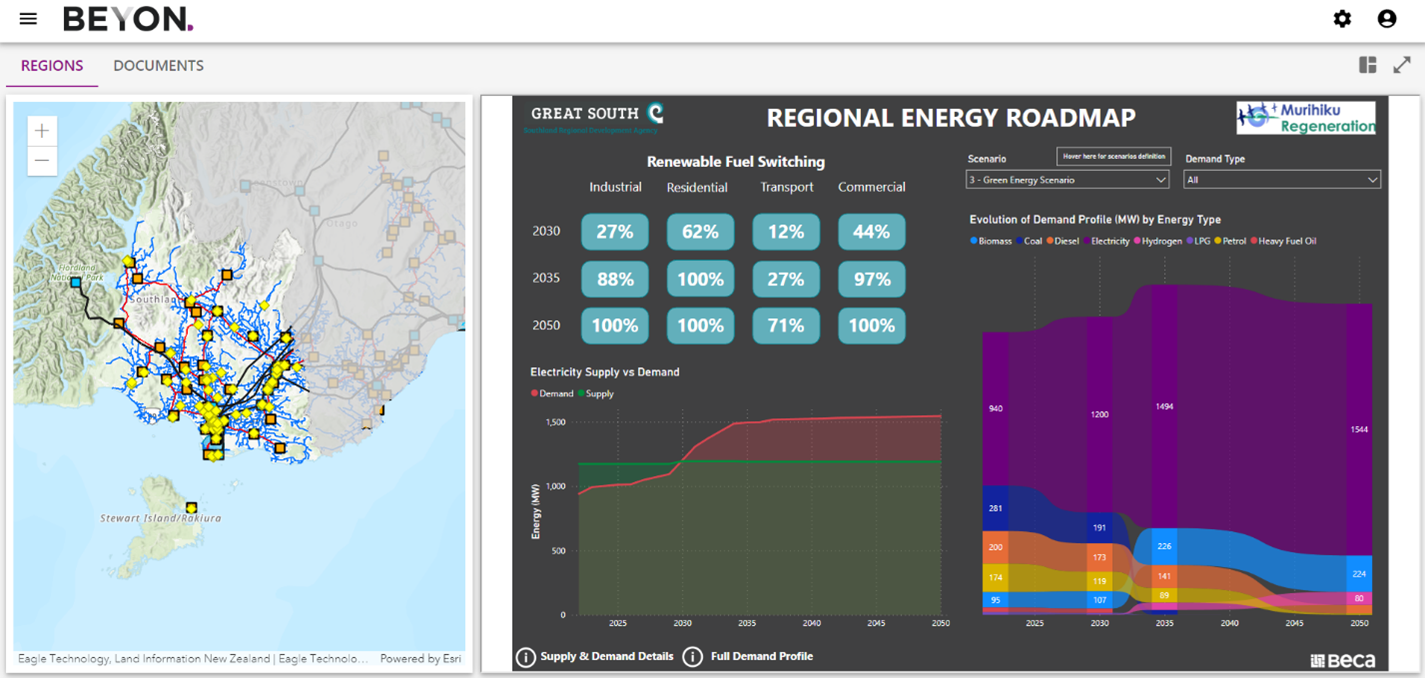
The Regional Energy Roadmap produced for the Murihiku Great South region enables dynamic evaliation of future energy and decarbonisation scenarios.
Enabling predictive decision making
BEYON [Digital Twins for Sustainable Growth | BEYON] is a digital twin platform created by Beca to connect complex data sources so that people can make the right decisions with confidence. A single pane of glass across all your asset information, it unlocks the true value of your data, regardless of its source system and without the cost of new systems or complex integration. BEYON is cloud-based, configurable, and off the shelf. It is designed to allow integration with existing systems and processes, and to adapt to future use cases.
“Digital twins are revolutionising how organisations approach sustainability,” says Stephen Witherden, Beca’s Technical Fellow for Software Engineering. “Digital Twins bring critical context to dry numbers allowing decision makers to use every resource at their disposal wisely. Seeing the natural and built environment not just as numbers but as a living, breathing, complex evolving thing in space and time affords better forecasting, simulation and ‘what-if’ analysis, resulting in better outcomes.”
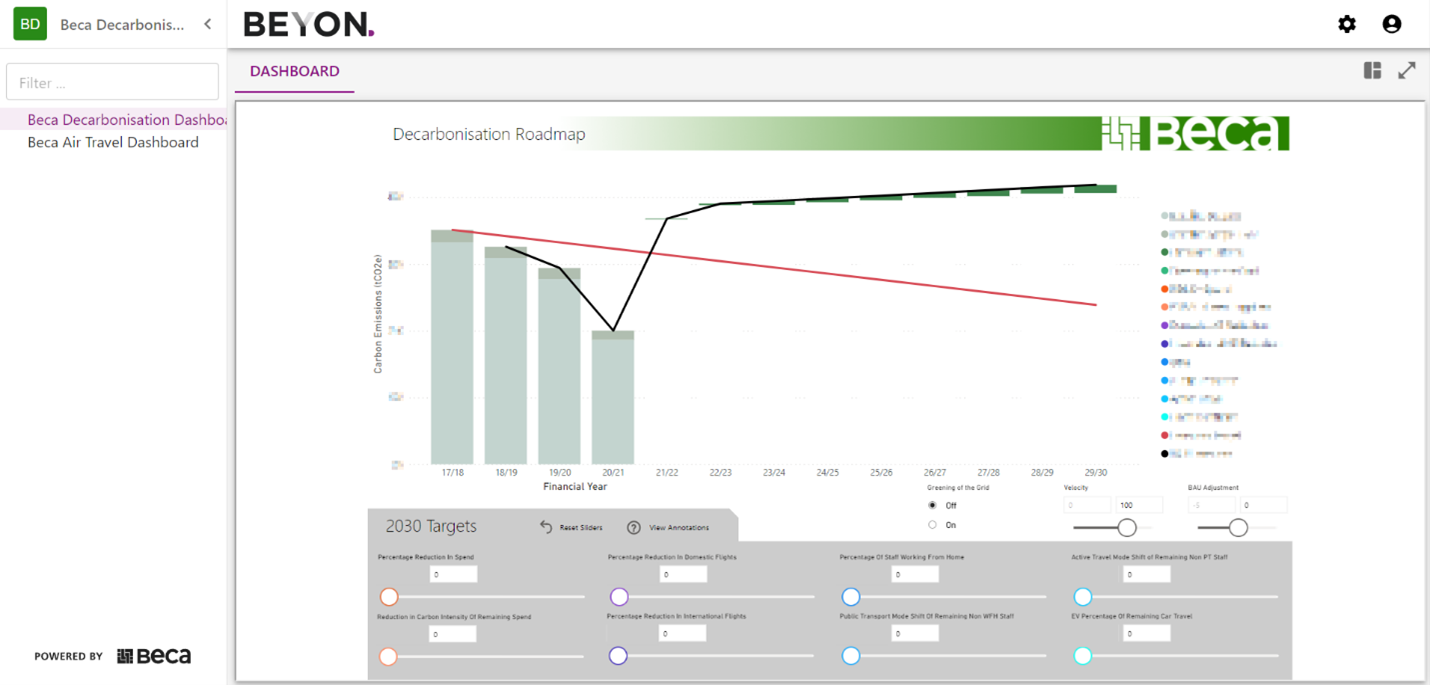
Example configuration of BEYONDirect for decarbonisation.
From an adaptation planning perspective, a digitised dashboard of a location such as a city or region, could utilise data from infrastructure, residents, businesses, mobility, climate, and sustainability goals to rapidly run comparative models based on any given scenario, enabling users to track the end outcomes of different decision pathways.
“Digital tools are a powerful way of illustrating and communicating complex messages about how our environment and important infrastructure may be impacted in the future. Being able to pull different levers to demonstrate future scenarios allows for the flexibility needed to make important decisions, despite the uncertainty,” says Beca Business Director Climate Resilience, Cushla Loomb.
The benefits of digital twins can be amplified when multiple system inputs are combined, and use is enabled across decision-making levels. Some areas where they can be particularly beneficial include:
-
Combining physical risks with mitigation strategies and conservation and carbon emission reduction tactics to evaluate possible climate outcomes
-
Mapping climate risks and flagging opportunities for projects and policies at planning stage
-
Enabling users to incorporate different future scenarios into decision making to optimise resources and assets
-
Integrating strategic, tactical and operational layers of a location for meaningful adaptation outcomes
-
Improving infrastructure investment for the long-term
-
Planning for disruptions
-
Optimising resource use, for example energy and water.
Case study: Beca's Climate Impact Lens
Assessing climate implications in planning investment in new infrastructure or maintaining existing assets is a complex task involving many interacting parts. Existing planning processes are often effective at looking at one climate risk or carbon mitigation opportunity in detail (e.g. a stormwater project that considers increasing extreme rainfall frequency, or a coastal project that considers sea level rise), but they often fail to consider the different elements at play across adaptation and emissions outcomes.
Having completed several climate strategy, governance and action planning projects for councils, Beca’s climate and adaptation specialists saw the opportunity to distil these experiences into a single digital platform to provide a more accessible and consistent solution to integrating climate risks and opportunities in decision-making.
The Climate Impact Lens (LENS) is a digital, outcome-driven solution designed by Beca's climate specialists and the BEYON team to aid the councils’ decision-making processes. By consistently considering projects’ climate and carbon emissions impacts, the LENS provides a single digital location to flag climate risks and opportunities for projects and policies at their earliest stages, working across adaptation (physical risks) and mitigation (carbon emissions) to evaluate climate factors and aggregate insights.
Condensing all council projects into a single dashboard across long term plans, asset management, budget or business line/department (depending on preference), the LENS screens for potential climate outcomes, then assesses the emissions and adaptation impacts. For mitigation, council and area operational and capital emissions impacts are assessed. For adaptation, the LENS guides the user through questions related to exposure (to hazards including fluvial and coastal flooding, coastal erosion, slips, wind, drought, and heat), vulnerability and consequence, then prompts users to consider risk mitigations that might be appropriate based on the risks identified. The assessment is based on various qualitative and quantitative inputs, such as council-specific hazard layers and qualitative scoring for various climate risks and emissions impacts. This allows the user to shape and adjust assumptions on a project level, to be shared and tested by others – or refined as projects mature. Having these layers incorporated allows easy inclusion of additional or new data as it becomes available.
The LENS then generates an output report for each project (or option), allowing the user to consider the project’s merits from a climate perspective, and supporting multi-layered decision-making from high-level strategic decisions through to individual project decisions. This increased transparency will be valuable for ongoing monitoring and reporting against climate goals.
Authors