Local authorities in Aoteroa New Zealand are facing significant fiscal and capacity challenges, compounded by the need to respond to climate-related weather events.
Dealing with the resilience challenge that lies ahead is a problem many local authorities do not have the resources to tackle. However there are some, like the city of Dunedin, that are investing to ensure that their communites are adapting.
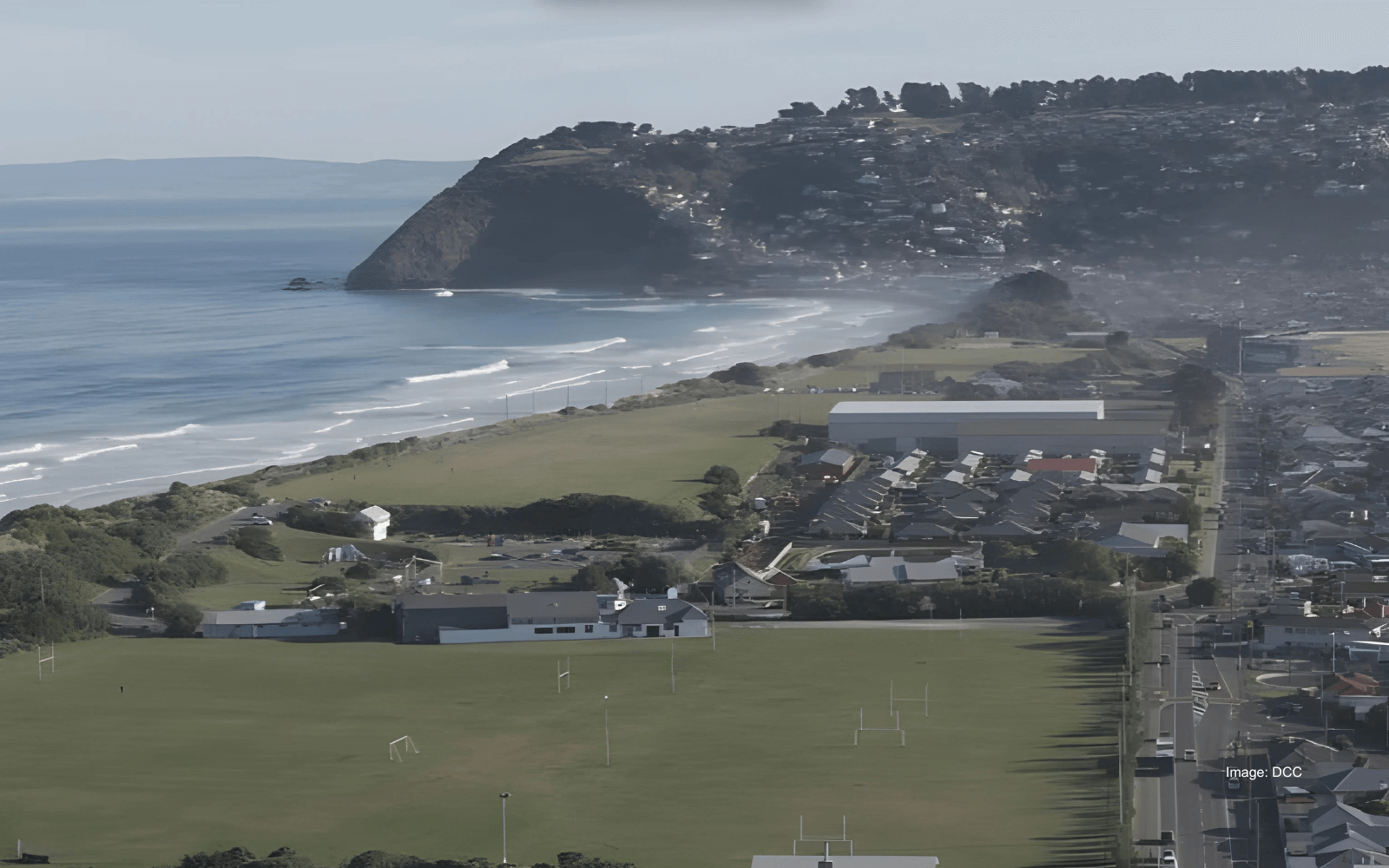
Communities in South Dunedin face one of the highest flood risks in New Zealand. This former coastal wetland has been developed, filled in and reclaimed, creating a basin with no natural outflows. Over time, erosion and high groundwater have impacted the community, and the sea level is estimated to have risen about 20 centimetres during the past 120 years. In 2015 and again in 2024 heavy rainfall exceeded the operating capacity of stormwater systems, which led to extensive flooding. These heavy rainfall events are expected to increase in intensity and frequency in the future, and rising sea-levels and high groundwater further exacerbate flood risk.
More than 2,700 homes are already within 50cm of present-day sea level, and over 70% of those are less than 25cm above present day sea level. When compared with the rest of the city, the population of South Dunedin is more ethnically diverse, older, has a higher proportion of people with mobility challenges, and is a lower socio-economic area. It is a community that requires practical, actionable pathways for adaptation.
The South Dunedin Future Programme involves a collaboration between local and regional councils, mana whenua (via the papatipu rūnaka owned consultancy, Aukaha Ltd.) and a consultant team (including Beca, G&T Connect, WSP and Tonkin + Taylor) working closely with the community to develop an adaptation plan.
To make a plan to adapt to climate change in South Dunedin, the local and regional Councils established five workstreams:
- Communications and Engagement
- Risk Assessment
- Adaptation Planning
- Strategic Programme Management
- Natural Hazards (delivered separately)
Together, these tell the story of adaptation planning for South Dunedin.
Communications and Engagement
Community engagement is at the heart of effective adaptation planning. In South Dunedin robust, two-way conversations will lead to stronger buy-in, deeper resilience, and fairer outcomes. But this isn’t easy. The risks are often decades away, while the decisions made now can shape generations. That’s why building and maintaining a long-term social license to act is both essential and complex.
Since the South Dunedin Future Programme began in 2023, more than 80 engagement sessions have been held with the community. These haven’t just been presentations, they’ve been conversations. We’ve shared the science, listened to local knowledge, and heard what matters most to people who live, work, and whakapapa here.
Now, we’re entering a new phase which is exploring possible futures together. This is where the real work begins. We’re working with the community to develop pathways that reflect shared values, provide clarity, and uphold the social license needed to navigate change over time.
Adaptation isn’t something we do to communities; it’s something we do with them. And in South Dunedin this commitment will carry us into the future.
- Gemma Greenshields, G&T connect
South Dunedin communities have been living with increasing climate hazards in area over the past decade. In addition to the episodic flood events, they contend with high groundwater on a near-daily basis. Some houses have small pumps to dewater their properties in order to be able to sustain a vegetable garden. Many of the older homes in the area are persistently damp resulting in health impacts. Because of this high groundwater, when it does rain, puddles can remain for days or weeks.
In the future, coastal flooding will become more frequent – including potentially overtopping the high ground near the coast, flowing into the lowland called the Flat.
The South Dunedin Risk Assessment brings together a picture of the flood-related challenges facing the area, from now through to the year 2100.
Risk Assessment
A clear understanding of what is at risk provides a strong case for change. The assessment of physical risks produced detailed information across many physical elements of South Dunedin, considering direct and cascading risks over time. While it doesn't provide all the answers, it represents a significant step forward for the programme. The increasingly complex picture of risk presents challenges in communicating the results to broad audiences, including clearly articulating the inherent limitations of any multi-hazard risk assessment of this scale. Ultimately, we are left to consider what is most material when assessing and communicating risk to inform community adaptation.
The concept of risk is broad and can vary significantly depending on the context and perspective. Consequently, there is no single best methodology or tool for a climate risk assessment that covers the time-varying, direct and indirect cascading impacts of climate. To navigate this, the SDF risk assessment workstream identified two primary aims: to outline the case for change and to support spatial adaptation planning. Complementary to these aims, the workstream adopted principles to guide decision-making regarding the often imperfect data inputs required for the assessment.
- Katherine Cowper-Heays, Tonkin + Taylor
Kāi Tahu hold mana whenua status in South Dunedin. A mana whenua risk assessment was facilitated by Aukaha Ltd to provide a holistic Te Ao Kāi Tahu perspective to the project. Kāi Tahu cultural values provided the basis for identifying risks, and the methodology was aligned broadly with Te Taki Haruru, Dunedin City Council’s Māori Strategic framework. As well as the risks to important places to mana whenua, the assessment considers risks to Kāi Tahu perspectives and values relating to wider environmental, political, social and economic factors across South Dunedin.
- Alex Gorrie, Aukaha, Ltd.
Adaptation Planning
Academic literature provides idealized ways to develop and implement flexible, open-ended adaptation plans with robust, resource intensive quantitative techniques. The SDF programme has incorporated elements of dynamic adaptive planning pathways (DAPP) scaled to the available time and resources to deliver an implementable long-term pathway.
This has at times meant deviation from theoretically ideal practice. Rather than a traditional engineering long list of options with each option evaluated individually or exploring the infinite combination of options, the team developed a list of seven possible adaptation futures to depict what South Dunedin could look like in 2100 in response to climate change. This accelerated thinking about systems level approaches and interactions and to engage with communities about what they want for the future of their children and grandchildren and has enabled multi-disciplinary assessments of possible futures, including a robust te ao Māori (indigenous Māori world view) lens provided by Aukaha. From here, we are building pathways beginning with low and no regrets actions and designing progressive interventions retaining where possible flexibility across as many possible adaptation futures as feasible.
While this approach has largely been effective for this context, there are tradeoffs between theoretical approaches to plan for uncertainty and requirements for vision and direction. We have attempted to balance providing government and communities with a plan and retaining the flexibility that climate change requires in the future to adapt to uncertainty when we shift into the implementation phase of adaptation planning.
- Laura Robichaux, Beca
Strategic Programme Management
Through the strategic programme management approach for South Dunedin, the various workstreams are weaved together by late 2026 informing the next funding cycle as a starting point for investment and change in South Dunedin. Successful implementation of adaptation planning hinges on clear thresholds, comprehensive understanding of urban economics and land-use opportunities relevant to a particular context, as well as funding and delivery mechanisms. Looking forward, uncertainty remains as to whether an implementation agency will be required as well as how the adaptation actions will be funded and realized.
- Joao Machado, WSP
Dunedin City Council (DCC) and Otago Regional Council (ORC) have been on a multi-year journey to understand the myriad natural hazards affecting South Dunedin, assess the associated risks, and identify a range of options and pathways for managing these over coming decades.
To make a plan, we’ve brought together a range of technical skillsets, working collaboratively and pivoting as required to meet the needs of Council and communities. The complexity of the challenges faced in South Dunedin have often appeared overwhelming; however, working together has proved integral to understanding the problem, interrogating it from multiple angles, and identifying a range of viable solutions in partnership with key stakeholders.
- Jonathan Rowe, Dunedin City Council
There are several options for managing and mitigating the risks identified which have been narrowed down to seven Potential Futures for South Dunedin, which help communities visualise what South Dunedin might look like depending on what decisions are made. This includes the ‘status quo’ and six other futures representing a spectrum of responses.
Read about the seven Potential Adaptation Futures here.
Next steps
We are presently developing a few shortlisted pathways. These possible pathways consider a series of actions over time, that are prompted when conditions change. The idea is that we allow future leaders to make the right decisions at the right time, but providing strong strategic direction and low-regrets actions in the present. In the meantime, there are several short-term interventions that can reduce risk for South Dunedin communities.