As extreme weather events and flash floods become more common, Auckland Council is working to address climate resilience and adaptation challenges in Tāmaki Makaurau Auckland.
To help with this work, Council sought to develop a climate change adaptation knowledge system that integrates data, information and knowledge to inform its decision-making processes. A multi-disciplinary team from Beca collaborated with Auckland Council's Resilient Auckland team to design a system that incorporates international best practice and indigenous knowledge.
In January of 2023, as Aucklanders began their Anniversary Day long weekend, the forecast heavy rain quickly became a regional disaster that caught the city by surprise. Parts of Auckland received more than a month’s worth of rain in one evening – approximately 245mm in 24 hours. Up to 10,000 properties flooded and hundreds of Aucklanders were forced into emergency accommodation.
While Auckland Council had plenty of data related to climate change and extreme weather events, retrieving the right data to make speedy decisions proved problematic. The event highlighted that the council had a knowledge management problem it needed to solve.
“Auckland Council realised they needed a better system for organising their knowledge when it comes to climate adaptation. After initially considering a platform of some kind, they have now moved towards a knowledge system in a more holistic sense. It’s about the people and information involved, rather than a tool,” Project Director Tracy Plane says.
Beca and Auckland Council engaged in a series of online workshops with representatives from various council units and Council-Controlled Organisations (CCOs). These workshops were further supported by targeted interviews to explore specific knowledge system needs in greater detail.
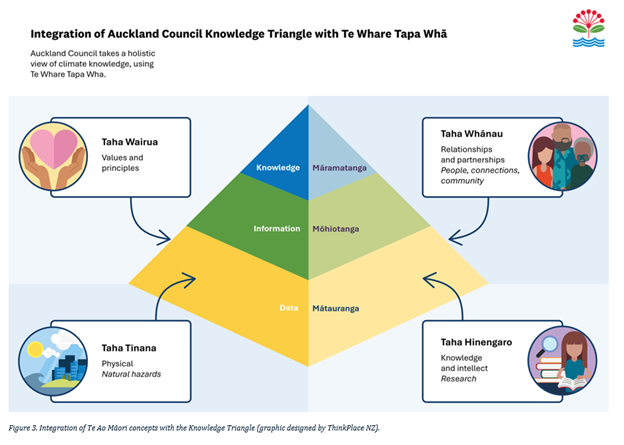
As part of this work, Te Ahi Tūtata (the Māori business team at Beca) made recommendations on how to incorporate te ao Māori (a Māori worldview) into Council’s knowledge management. Mātauranga Māori, mōhiotanga, and māramatanga became part of the knowledge system design, as did the Te Whare Tapa Whā model of holistic wellbeing.
Kaiwhakatere (Project Navigator) Jason Tate was part of the Beca team that worked with Auckland Council on this project and has provided advice to other local government organisations.
“Using Te Whare Tapa Whā is a smart way to go about things. It’s a real collaborative approach drawing on the wisdom of past, present and future. Everyone contributes to the final solution. The four realms of taha tinana, taha wairua, taha whānau and taha hinengaro have long existed within te ao Māori. What Sir Mason Durie did was elegantly synthesise them into a framework specifically for mental-health and wellbeing practice. We’re now adapting that same framework to our knowledge-system context, the people we engage with, and the outcomes we’re aiming for,” Jason says.
The scoping report for the knowledge system was essentially a thought piece, guided by the "Knowledge Triangle” model, which defined various steps and actions to evolve from data stage to shared understanding, and incorporated te ao Māori concepts to create a holistic and inclusive framework.
Following this scoping report, Auckland Council engaged Beca to help them develop a Knowledge Management Plan.
Beca worked closely with Council teams to understand existing challenges and opportunities. Beca’s approach included a current state assessment, stakeholder engagement, and the design of practical tools and roles to support implementation. This included the introduction of knowledge brokers, a centralised intranet page, and a modern data platform to streamline access and collaboration.
The Knowledge Management Plan identified immediate, near-term, and long-term actions. This phased approach allowed Auckland Council to begin implementing improvements quickly, while building capacity for more transformative change over time. The plan integrates te ao Māori concepts to support more inclusive and values-led decision making, while acknowledging the unique cultural and environmental context of Tāmaki Makaurau.
As extreme weather events become more frequent due to climate change, and parts of Auckland flood more frequently, Council is making sure both its teams and its constituents are well prepared.
Our client says…
“I’ve found the team at Beca to be great at collaborating. It’s felt like having new helpful, productive and expert colleagues.”
Bonnie Apps
Principal Policy Advisor for the Resilient Tāmaki Makaurau Programme, Auckland Council
Our People