
At a time of dramatic data growth and increasing artificial intelligence (AI) adoption, demand for hyperscale and colocation capacity is rising across the next generation of data centres.
The facilities of tomorrow are being designed today, with efficiency a key criteria; spanning energy use, operational performance and constructability.Effective data centre design requires careful planning across multiple considerations, including securing an uninterruptible power supply, utilising renewable energy sources, adhering to regulatory requirements, and implementing necessary security measures to support the cloud computing and data storage systems on which organisations increasingly rely.
These demands are further amplified by emerging technologies with higher density AI workloads, as well as innovations such as liquid cooling, and large-scale hyperscale facilities.
Beca’s teams bring multidisciplinary expertise across sectors, supporting clients to design next-generation data centres with layouts that integrate sustainable design principles, and accomodate high-density equipment.
This blog series (view Part 2 here) will serve as a practical guide for developers and original equipment manufacturers (OEMs) on essential data centre design considerations.
Key design principles for next-generation data centres
This era of big data isn’t new, but what is new are the multifaceted demands organisations across industries are making of data centre infrastructure. Data growth is only one aspect of this; there’s also the increasing ubiquity of machine learning (ML) and AI workloads, the demand for cloud and edge computing and even burgeoning interest in quantum computing. This is a lot to ask of a legacy facility.The global data centre sector is experiencing a compound annual growth rate of 14% through 2030 and is an infrastructure investment supercycle requiring up to $3 trillion by 20301. As we collectively build more data centres, it’s essential to design next-generation facilities with layouts and physical infrastructure that can handle all these demands.
Here are some key design principles that are quickly becoming pillars of modern data centre construction:
1. Efficiency-first architecture
Data centres can run hot (very hot!). That's why it's important to optimise the physical layout for airflow, cooling pathways and high-density racks. Furthermore, it can be hugely beneficial to right-size space early, avoiding overbuilding yet planning for incremental expansion.
A foundational data centre best practice is the traditional hot aisle/cold aisle approach. This design arranges server racks in alternating rows, facing each other, to separate cold supply air from hot exhaust air. By preventing mixing, it improves energy efficiency and overall system performance.
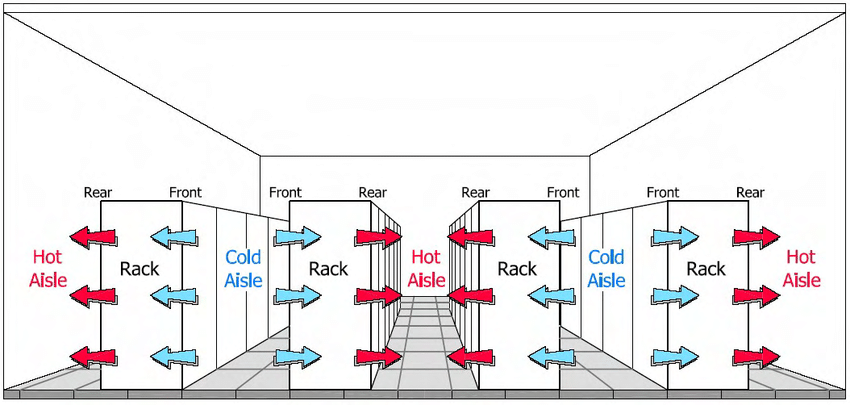
Figure 1-4. Typical Data Center HVAC Hot Aisle / Cold Aisle Layout2
More advanced approaches include Containment-Based Cooling, In‑Row and Close‑Coupled Cooling, providing efficiency in modern environments.
At the same time, there is a growing demand for higher power density; ranging from 20–50kW per rack and increasing to 100kW per rack for AI and hyper-computing. The shift is driving the adoption of rack based cooling and liquid cooling technology, making it critical that designs maximise cooling system effectiveness.
Local climate is also another important consideration. In Australia and New Zealand, many regions experience conditions such as hot summers and periods of high humidity, and these must be accounted for. However, these regions also offer opportunities for free cooling due to their temperate and seasonal climes, particularly during cooler months. Leveraging these conditions can significantly enhance cooling efficiency, making climate responsive design an essential part of the data centre planning process.
2. Flexibility and modularity
Modular plantrooms, prefabricated mechanical, electrical and plumbing (MEP) skids and phased deployment are becoming common practice for next-generation facilities. Modular plantrooms are pre-built, self-contained units that house mechanical and electrical systems: HVAC, pumps, switchgear, etc. These can be built offsite for quick, quality-controlled installation, reducing onsite disruption and accelerating the construction program. MEP skids are pre-assembled, modular units built on a single frame (skid), for easy transport and "plug-and-play" installation.
Plantrooms and skids allow for phased deployment. This boosts flexibility, as do removable server rows and scalable mechanical/electrical systems. All this gives construction and maintenance teams more time and space to work with when they need it, which can have knock-on benefits. For example, this type of design can grant the ability to add extra UPS modules, cooling modules and switchboards, as well as adaptive space for future liquid-cooling retrofits as needed.
3. Resilience and risk mitigation
For all the technological advancement of modern data centres, redundancy remains key. It's important to design around the level of redundancy that's most appropriate for a given facility: N, N+1, 2N or 2N+1. N+1 is cost-effective, while 2N is better for centres that need very high uptime. 2N+1 is for mission-critical systems that must avoid downtime at all costs3.
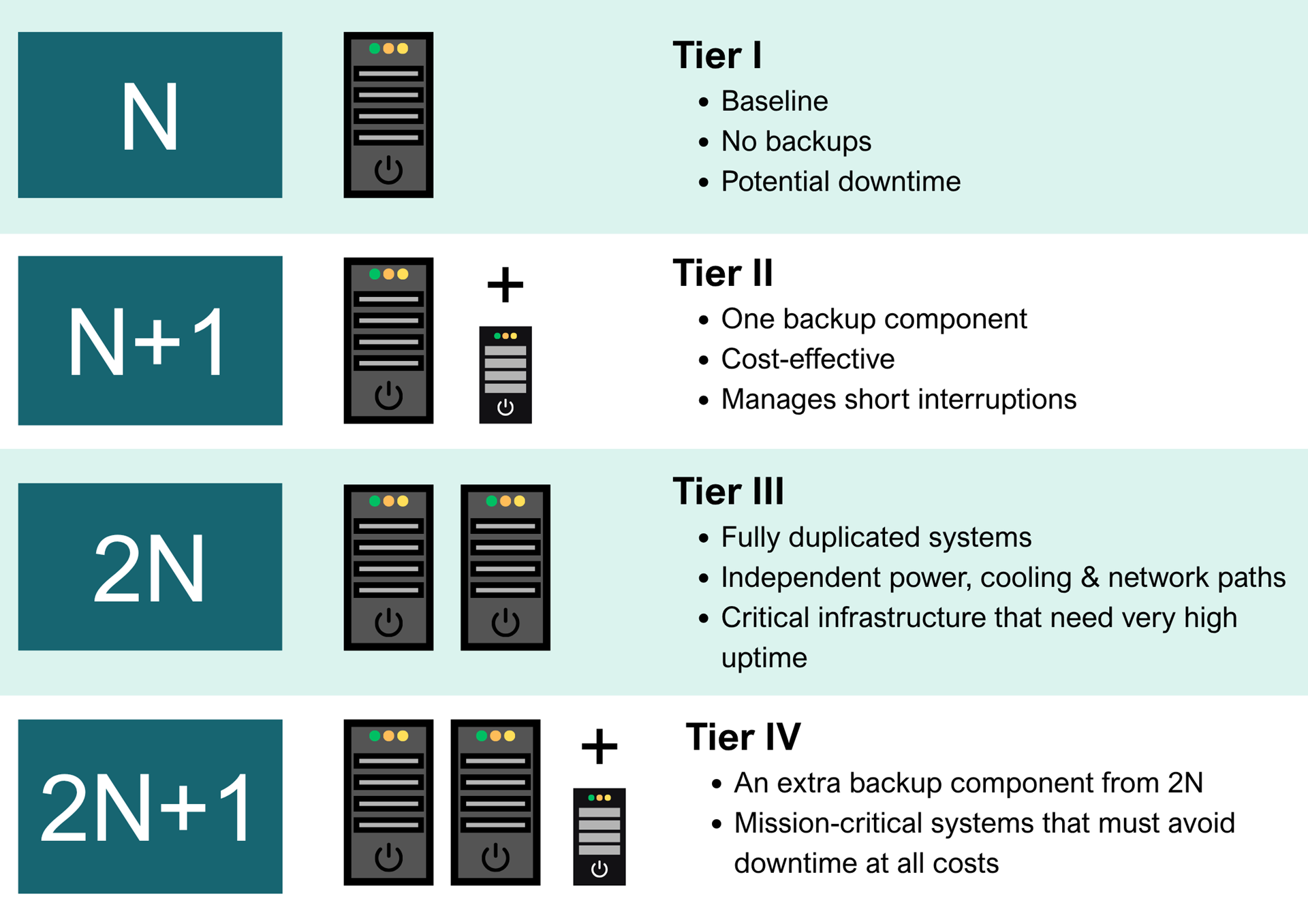
Building in redundancy minimises single points of failure (SPoF), so that even when something goes wrong, the facility can continue to operate. This includes incorporating backup generators, Uninterruptible Power Systems (UPS), suitable redundancy in cooling equipment/infrastructure, and adhering to seismic resilience requirements, such as AS/NZS 1170.
And, of course, there's cyber and physical security. It's important to consider security measures in both design and practice, such as how the physical infrastructure itself can support security in addition to what on-site and cybersecurity teams are doing.
It's helpful for different teams, from engineering to finance to project management, to understand the Uptime Institute TIA Tier Standard4. This tier standard provides an excellent way of measuring data centre efficiency. Tier I is the base level of redundancy, while a Tier IV facility has numerous independent and physically isolated systems that act as redundant capacity components and distribution paths.
Resilience is also an important consideration when it comes to natural disasters such as earthquakes. Beca have globally sought after expertise in seismic design for structural and non-structural elements, which includes all the elements within the building.
4. Sustainability and lifecycle design
There is growing concern over the significant amounts of energy and water consumed by data centres, as well as the embodied carbon associated with their construction and infrastructure5. To reduce costs, comply with environmental regulations, and avoid negative public opinion, maximising sustainability from the design phase is essential. This includes addressing both operational impacts and upfront emissions from materials and equipment selection. Circularity is often key to sustainability, with a focus on reusing, recycling, and recovering materials wherever possible to reduce resource use and embodied carbon over the asset’s lifecycle.
This is another reason to design a facility that allows for repurposed spaces as equipment generations evolve. Furthermore, planning for end-of-life decommissioning or adaptive reuse demonstrates a commitment to sustainability beyond simply efficient energy and water use.
5. Layout optimisation for airflow and space efficiency
An optimised data centre layout requires spatial density planning for AI and hyper-computing clusters vs. general compute racks, as these servers have different requirements. It's also highly advantageous to minimise cable congestion and overhead/underfloor constraints. Furthermore, designing equipment rooms for safe maintenance clearances and future row expansion grants immediate efficiency benefits and potential advantages down the road.
Ultimately, an efficient and optimised facility requires careful planning long before construction begins. Data centres are designed through teamwork between architects, engineers, planners and OEMs, requiring various expertise, from a knowledge of environmental law to electrical engineering. By carefully considering layout, airflow, electrical capacity, resilience and sustainability from the beginning, early-stage architectural and MEP collaboration improves density and efficiency.
Protective Security
Finally, effective physical security for data centres must be embedded in the design from the outset. This includes site layouts that establish clearly defined security lines, zoning, and layered defence, with controlled and auditable entry and exit points for people, vehicles, and materials. Security operations are supported through integrated access control, surveillance, and monitoring systems, often coordinated via a centralised Security Operations Centre (SOC), providing real‑time visibility across the facility. Beca brings extensive experience in designing high‑security environments and complex access control systems for specialised facilities, so that protection of critical data and high‑value assets is robust, resilient, and aligned with client and regulatory expectations.Together, these principles form the foundation of a high-performance data centre. In Part 2, we look at how these concepts are implemented through energy, cooling and infrastructure systems to deliver resilient, efficient facilities at scale.
Want to learn more? Get in touch to discuss upcoming data centre projects or feasibility studies.

Sources
- JLL- 2026 Global Data Center Outlook
- ResearchGate - Report to Congress on Server and Data Center Energy Efficiency: Public Law 109-431 - Scientific Figure on ResearchGate
- STULZ Oceania - What is Data Centre Redundancy? N, N+1, 2N, 2N+1 Explained
- Uptime Institute - Tier Classification System
- EESI - Data Center Energy Needs Could Upend Power Grids and Threaten the Climate
Authors