What does the future of integrated urban development look like? Singapore’s Punggol Digital District (PDD) offers an impressive blueprint for the wider Asia Pacific region and beyond.
Key highlights
- Singapore’s first fully integrated smart business hub, supporting the country’s Smart Nation ambitions.
- A 50-hectare masterplanned precinct bringing together government, industry, academia and community spaces.
- Developed by JTC Corporation, with architectural design by WOHA Architects. Beca contributed Mechanical and Electrical Engineering (M&E) expertise.
- A benchmark for precinct-scale digital infrastructure, including an Open Digital Platform, cloud-based building systems and smart technology integration.
- A model for sustainable, car-lite urban development, combining public transport, active mobility, community infrastructure and greener building systems.
- A regional reference point for future smart business districts, with lessons for markets across Southeast Asia, Australia, New Zealand, the Pacific and beyond.
As Singapore continues its journey towards becoming a truly Smart Nation, the 50-hectare Punggol Digital District masterplanned precinct stands testament to the power of partnership. Imagined as the country’s first fully integrated smart business hub, it has brought together government, private sector and academia; delivering a landmark, mixed-use commercial, residential and educational development.
This article explores the journey behind Punggol Digital District’s development, and what it means for the future of smart business districts in Singapore and beyond.

Punggol Digital District: The power of partnership
At the heart of Punggol Digital District’s (PDD) story is a highly integrated partnership model. Like much of the Lion City’s urban development, PDD is the result of careful, long-term planning by Singapore’s central government – led in this case by statutory authority JTC Corporation.
Government, private sector and academia working together
With PDD’s vision set by the central government, JTC engaged a team of multi-disciplinary consultants to bring it to life. This included Beca and Ramboll as engineering consultants, Engie as a specialist contractor and Singapore Institute of Technology (SIT) as the district’s academic anchor.This approach differs from the more siloed, private developer-led models common in Australia and New Zealand where new urban developments are often delivered separately from government, rather than as part of a grand, long-term city-shaping plan.
At PDD, integration is intentional: with planning, engineering, digital infrastructure and future operations all considered together to support Singapore’s broader Smart Nation objectives. A good example of this: Punggol Coast MRT station was opened in December 2024, ahead of the district’s completion in 2025, ensuring full integration with the broader public transport network from day one.
Collaborative delivery of district-wide smart systems
The strength of this partnership model was evident in how complex district-wide systems were delivered. Even where Beca was not the lead consultant on every system, close collaboration with the developer and other consultants allowed a shared technical vision to be realised.For example, working closely with Ramboll and Engie, we played an important role in bringing to life PDD’s cloud-based Building Management System (BMS), district cooling system, integrated energy systems and smart lighting infrastructure.
Aligning the priorities and expectations of diverse stakeholders – including central government and private businesses – delivered a precinct where systems work seamlessly together, rather than competing for space, data or control. To make this happen requires trust and a willingness to learn from one another.
smart, sustainable district where innovations in smart living are pioneered and integrated with
extensive tech leaning business parks, smart infrastructure and various community facilities”
- Mr Yik Yu Hock, Beca Job Director
2025 BCA Awards video showcasing Punggol Digital District’s winning attributes.
Video Credit: BCA Singapore, 2025
Delivering city-shaping innovation through digital infrastructure
Punggol Digital District’s physical form reinforces its digital ambitions. As a true smart business district, all its buildings are connected via an Open Digital Platform (ODP) that allows seamless ‘plug and play’ connectivity for various building systems in a technology-agnostic manner.
Smart, sustainable & car-lite design features
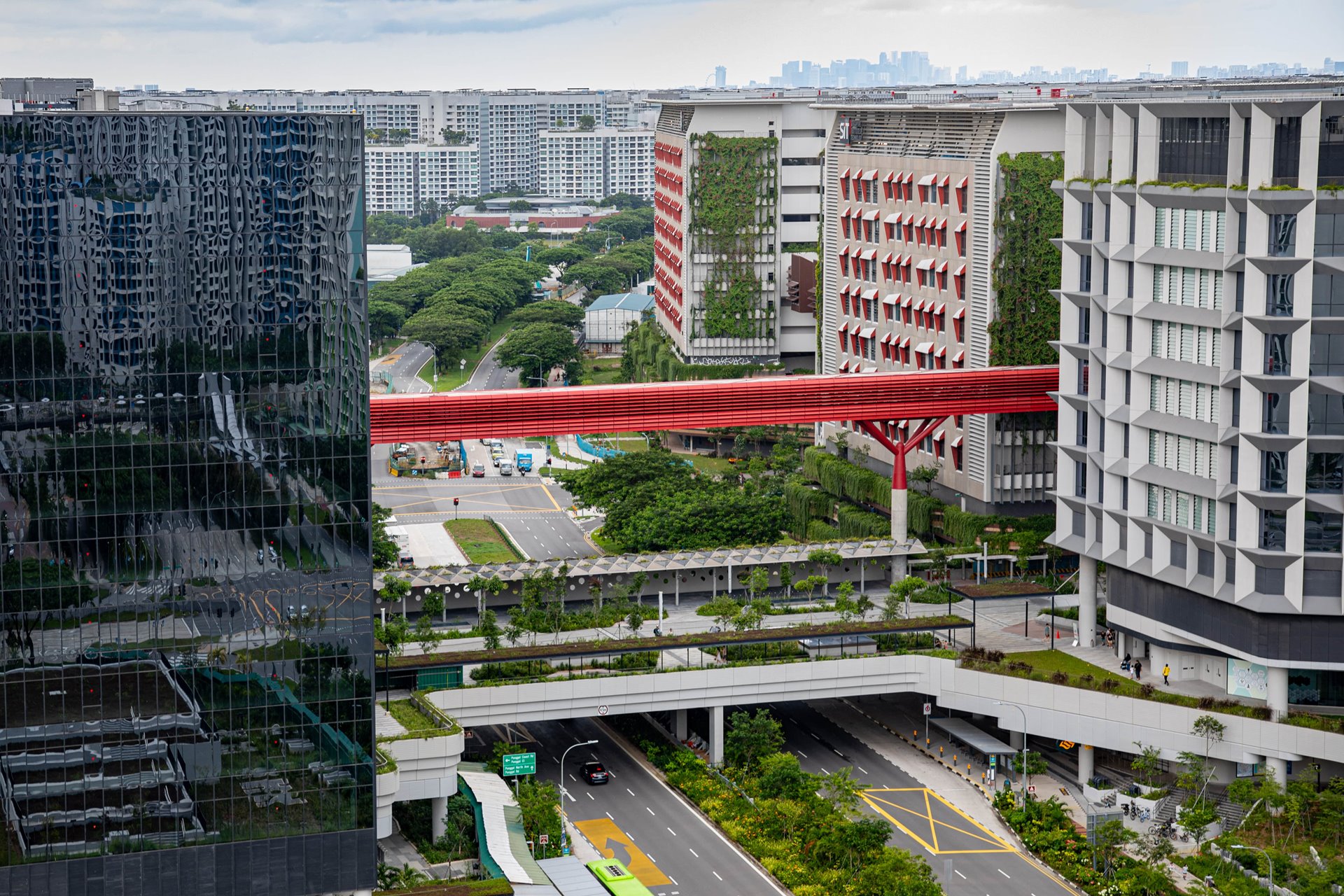
One of the district’s defining features is its car-lite design that places pedestrians above vehicles. Roads and parking are located underground, whilst active transport and community spaces are at ground level. This reduces car dependency and creates a more livable precinct, connected directly to public transport via Punggol Coast MRT station.
Digitally, the district is underpinned by a cloud-based Open Digital Platform (ODP). Developed by JTC and GovTech Singapore, the ODP serves as PDD’s digital backbone, bringing together various systems to optimise building management and resource efficiency, using a vast network of 20,000 IoT (Internet of Things) sensors.These sensors help operate the following features:
- Facial recognition technology - for secure access control.
- Cloud-based Building Management System (BMS) - for real-time monitoring and control of air conditioning systems.
- Smart lighting systems - to optimise daylight use and reduce energy consumption.
Mass-engineered timber construction, including in Tower Four, alongside energy-efficient systems and water-sensitive urban design practices such as rainwater harvesting, further reinforces positive sustainability outcomes.
Smart design decisions: Maximising scarce urban space
Other notable design decisions that have delivered great outcomes for Punggol Digital District users include:
- Multi-Purpose Basement Emergency-Protection Zone (Dual-Mode Infrastructure) – Integrating these zones into PDD’s basement levels provides immediate, high-capacity safety for residents, workers and students during a national emergency. This dual-mode design allows a seamless transition from regular day-to-day usage (such as car parking) to the immediate activation of emergency mode if required – enhancing civil resilience and safety. During a crisis, the district’s centralised management systems will monitor and control the environment within these zones, ensuring public and occupant safety.
- Public Dining and Social Commons (Hawker Centre) – A Hawker Centre was integrated into the heart of PDD. As an important placemaking decision, it preserves Singapore’s cultural heritage and ensures the district remains a vibrant, inclusive community space, rather than a sterile business park. This Hawker Centre serves as the “social glue” between the Singapore Institute of Technology (SIT) campus and private sector tenants, facilitating deep collaboration and continuous learning that’s central to JTC’s vision.
- Integrated Bus Interchange – Placing the local bus interchange adjacent to Punggol Coast MRT Station has created a truly integrated public transport hub, enabling multi-modal connectivity, whilst reducing car dependency and lowering the district’s carbon footprint. This setup embodies the “integration is intentional” philosophy that’s prominent in Singapore’s approach to urban planning. By planning transport, digital systems and operations from the outset, PDD serves as a scalable template for future development across the region.
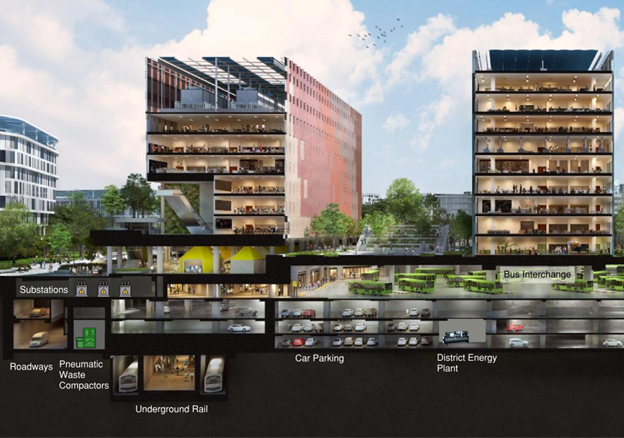
Image showing how Punggol Digital District is integrated with public transport and a Multi-Purpose
Basement Emergency-Protection Zone. Image Credit: WOHA Architects, 2025
Learning and adaptation: What PDD teaches us about collaborative engineering
For Beca, this project highlighted the value of collaborative engineering. In providing conceptual design for PDD’s building services, we worked alongside partners with specialist expertise, including Ramboll’s smart systems capability and Engie’s district energy solutions. Rather than attempting to lead every technical domain, our team focused on contributing where we could add the most value. This openness enabled innovation to be embedded at precinct scale, with solutions fit for long-term operations, not just the initial delivery.drives technological growth in the country, we are honoured to have played a part in this journey through
our involvement in the design of building services for the Punggol Digital District project”
– Lee Ang Seng, Former Managing Director, Beca Singapore
PDD’s positive impact: Lessons for the wider region
Punggol Digital District’s technical achievements have been recognised internationally, reinforcing the role collaboration played in delivering transformative outcomes.
Awards & accolades: Recognition for sustainable, integrated precinct design
PDD has received BCA Green Mark Platinum certification for Green Mark Districts and Super Low Energy performance, reflecting its environmental credentials. In 2025, it was awarded the Council on Tall Buildings and Urban Habitat (CTBUH) Award of Excellence – Systems, acknowledging its advanced, integrated system design and contribution to occupant wellbeing. That same year, it was also recognised in the BCA Awards - Project of the Year (Mixed Use) category.
A template for the region
Beyond awards, PDD is increasingly viewed as a reference point for smart business districts across Southeast Asia and the Pacific. As other countries seek to balance economic growth with digitalisation and sustainability, Singapore’s example shows what’s possible when long-term government vision is paired with trusted private sector delivery partners.
Transferable insights: Lessons for Australia, New Zealand & beyond
Several lessons from PDD are highly relevant to other parts of the world, including Australia and New Zealand:
- Government leadership & vision: The first is the importance of government leadership in setting a clear vision of integrated urban development and creating the conditions for collaboration to thrive within this framework.
- Integrated planning: Second is the value of integrated planning - bringing infrastructure, buildings, digital systems and operations together from the outset.
- Collaboration: Finally, collaboration between government, industry and academia can accelerate innovation by connecting research, talent and real-world application in a shared environment. Political continuity and long-term planning also played critical roles, enabling urban design decisions to be made with future decades - not just years - in mind.
While not every city can replicate Singapore’s model directly, the principles underpinning PDD are indeed scalable. Cloud-based systems, modular digital and integrated delivery models can be adapted to different contexts. For markets such as Australia and New Zealand, where assets are often delivered in isolation, PDD offers a compelling case for earlier and deeper collaboration.
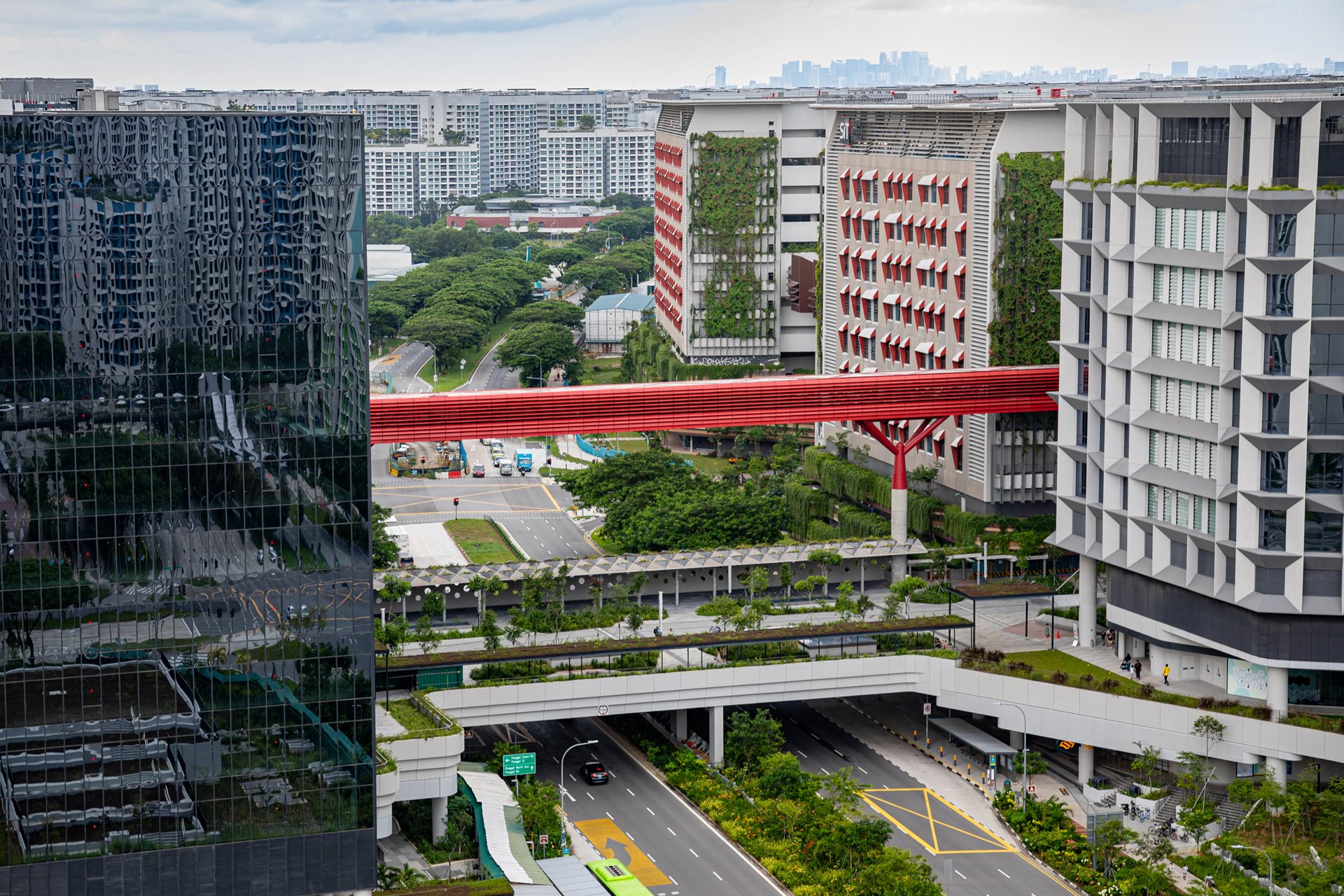
Aerial view of Punggol Digital District. Image Credit: WOHA Architecture, 2025
Conclusion
Punggol Digital District demonstrates that smart business districts are defined not by cutting-edge building technology alone, but by the partnerships that bring them to life. Through collaboration at scale - across government, industry and academia - PDD has set a new benchmark for how smart, sustainable precincts can be planned, delivered and operated.For engineering consultancies like Beca, the project reinforces that partnership is part of our DNA. By harnessing multi-disciplinary expertise across regions and markets, we can help shape future-ready urban precincts that make everyday better through supporting economic growth, environmental sustainability and human wellbeing.
Punggol Digital District shows what’s possible when collaboration is not an afterthought, but the very foundation on which future‑ready cities are built.
Read more about Beca’s Smart Buildings capabilities here.
Authors

Aung Kywe Nyunt
Senior Associate Director - Building Services